
The short answer
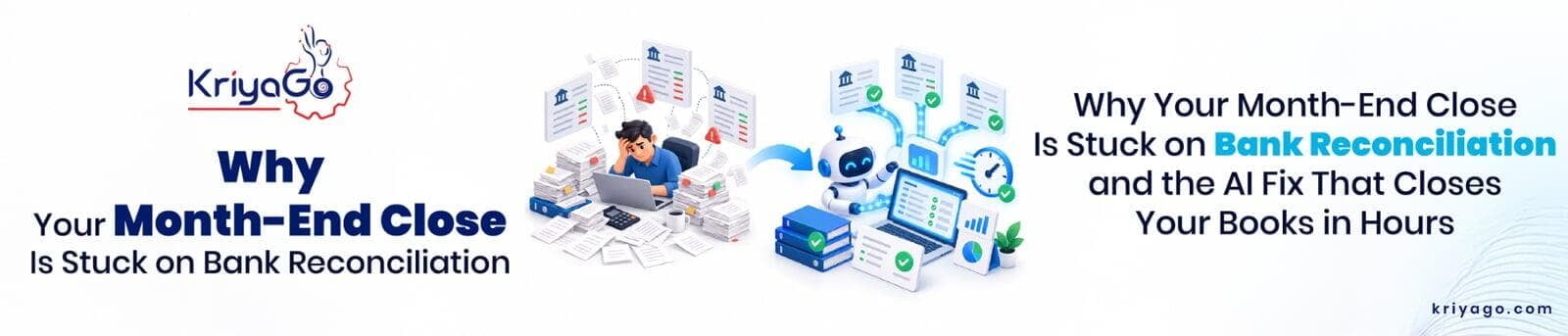
Your month-end close isn't slow because any single task is hard. It's slow because the close is a dependency chain, and bank reconciliation sits near the front of it. Until the bank is reconciled, cash is unconfirmed, sub-ledgers can't be trusted, and every downstream step waits. That's why a close that “should” take a day stretches across a week. Automate reconciliation to make it continuous instead of a month-end scramble, and the whole calendar collapses. That is exactly what KriyaGo's Treasury 360 is built to do: cut daily reconciliation from hours to minutes and the full close from days to hours.
If you're a controller, financial controller, or finance manager at a property company, fund manager, or REIT, particularly across Australia and New Zealand, this one is for you.
About KriyaGo:
KriyaGo is an AI-powered automation platform for the real estate industry. It connects banks, ERPs, and payment systems. It automates the finance and operations work that property teams still do by hand bank reconciliation, invoice processing, cash management, CAM reconciliation, lease abstraction, and more. Treasury 360 is KriyaGo's financial-operations solution.
The month-end close is a chain, not a checklist.
Walk into most finance teams during close week, and you'll see a task list: reconcile the bank, post accruals, run intercompany, review the trial balance, produce owner and investor reports, lodge. It looks like a set of parallel jobs that need enough hands.
It isn't. Each step depends on the integrity of the one before it. You can't trust the trial balance until the sub-ledgers tie out. You can't tie out the sub-ledgers until cash is confirmed. And you can't confirm cash until the bank is reconciled. Bank reconciliation isn't one task among many; it's the gate everything else passes through.
This is why “throw more people at the close” rarely works. A second AP clerk doesn't help if everyone is waiting on the same reconciliation to clear. The constraint isn't capacity. It's sequence, and the constraint lives in bank rec.
Why bank reconciliation is the real bottleneck
Three structural reasons make reconciliation the slowest, riskiest link in the chain, especially in real estate.
1. It's genuinely a three-way problem.
In property finance, reconciliation isn't just “does the bank match the cashbook.” It's a three-way match: bank statement to ERP ledger to the underlying invoices and receipts. Rent receipts, CAM charges, owner disbursements, supplier payments, and fee drawdowns must line up across all three sources. When one is off, someone has to investigate, and investigation doesn't scale with headcount.
2. The exceptions are where the time goes.
If 95% of transactions auto-match, the relief is short-lived. The remaining 5% timing differences, duplicated references, part-payments, unidentified deposits eats the majority of the effort. Manual reconciliation forces a human to chase each one across multiple bank portals and email threads.
3. Volume multiplies with every entity.
One property is manageable. A portfolio of dozens or hundreds of entities, each with its own operating and trust accounts, turns reconciliation into a combinatorial problem. Discrepancies don't add; they compound. Miss a few early in the month, and you're untangling them at 9 pm on day three of close.
The result is predictable: reconciliation is where the close stalls, and because it sits early in the chain, the stall cascades into everything after it.
This is a controller problem, not an AP clerk problem
Here's the reframe that matters. Bank reconciliation is usually filed under “accounts payable” or “junior bookkeeping,” so it gets treated as a low-level chore. But its failure modes land squarely on the controller.
When reconciliation runs late:
• Reporting slips.
Owner statements, investor reports, and board packs go out late and late reporting erodes confidence faster than almost anything else in finance.
• Cash decisions are made blind.
If you don't know confirmed cash until day four, you're managing liquidity on stale data. Funding shortfalls, idle balances, and missed transfers all become more likely.
• Audit exposure grows.
Late, rushed reconciliations without a clean trail are exactly what auditors flag. The cost resurfaces months later as a painful, expensive audit.
• Your best people burn out.
Senior accountants spend nearly a week as matching machines rather than analysts. Over time, that's a retention problem as much as a productivity one.
Reconciliation looks like a clerk's task. Its consequences are a controller's problem. That gap is precisely why the close deserves executive attention, not just more overtime.
The ANZ pressure points make this worse.
For finance and property teams across Australia and New Zealand, the bank rec bottleneck carries extra weight, because reconciliation here isn't only good hygiene; it's a regulatory obligation.
Trust accounting raises the stakes.
Real estate agencies and property managers hold client money rent, bonds, sales deposits, owner funds in designated trust accounts, separate from operating funds. Regulators treat this as a high-trust discipline with effectively zero tolerance for shortcuts. The standard is a monthly three-way reconciliation matching the bank statement, the cashbook, and the individual client ledgers, with the trust ledger total matching the bank balance exactly at period end.
Audit season is a hard deadline.
Across most Australian jurisdictions, the trust audit period ends 30 June, with lodgement deadlines close behind on 30 September in New South Wales and Western Australia, and Victoria adding a rule to lodge within ten business days of receiving the auditor's report. A risk-based audit must survive twelve months of signed, dated reconciliations. A year of rushed, late reconciliations becomes a very expensive few weeks.
A new compliance layer arrives in July 2026.
From 1 July 2026, Australian real estate professionals come under the federal AML/CTF regime overseen by AUSTRAC, adding customer due diligence and suspicious-matter reporting on top of existing state trust obligations. Reconciliation is the control layer that surfaces the unusual transactions this regime expects you to catch and report. If your reconciliation is slow and manual, your AML controls are slow and manual too.
In ANZ, the same reconciliation that gates your close also underpins your license, your audit outcome, and, from mid-2026, your AML compliance. The cost of leaving it manual keeps climbing.
The fix: reconcile continuously, don't “do bank rec” at close
The breakthrough isn't doing reconciliation faster during close week. It's making reconciliation a non-event by the time close week arrives.
When transactions are matched daily automatically, against live bank feeds, with only genuine exceptions surfaced for human review, there's no reconciliation backlog waiting on the first of the month. Cash is already confirmed. Sub-ledgers already tie out. The gate is already open. The close becomes a review-and-publish exercise, not an excavation.
That shift from periodic batch reconciliation to continuous, AI-driven reconciliation is what actually accelerates the month-end close. Everything downstream stops waiting.
How Treasury 360 collapses the bottleneck
Treasury 360 is KriyaGo's unified financial-operations solution, built with real estate DNA. It combines three AI engines that together remove the reconciliation gate from your close calendar.
KriyaBalance - intelligent bank reconciliation
KriyaBalance connects directly to your banks for real-time transaction feeds, then uses AI to match transactions across your ERP automatically and flag only genuine discrepancies. It runs the full three-way match from bank to ERP to invoices, handles credit card reconciliation, and works on an exception-only review model, so your team touches the 5% that needs judgment instead of the 95% that doesn't. Daily reconciliation that once took hours drops to roughly ten to fifteen minutes.
KriyaVision - AI invoice intelligence
Reconciliation is only as fast as the data feeding it. KriyaVision reads and understands any invoice format with OCR and AI, auto-codes to the correct GL accounts, and even logs into utility and tax portals to fetch bills, then creates the entries in your ERP without manual keying, at around 95% auto-coding accuracy. Clean, coded, timely payables mean fewer reconciliation exceptions in the first place.
KriyaCash - payment and cash control
KriyaCash gives controllers real-time cash visibility across every property and account, generates accurate cash flow statements on demand, and uses AI to suggest fund movements that keep balances positive with electronic payments and approval workflows built in. Because cash is continuously reconciled and visible, liquidity decisions no longer depend on a finished close.
Treasury 360 connects to direct bank feeds and to ERPs including MRI Software, NetSuite, Procore, and Zoho, so it fits the systems ANZ property and finance teams already run.
The measured impact
Based on KriyaGo's reported client implementations, Treasury 360 delivers around 72% less time on reconciliation, a monthly close in 3–5 hours instead of 3–5 days, daily bank reconciliation in about 10 minutes, roughly 80% less manual finance work, a 100% audit trail, and an average of about $4.2M in annual savings. The headline isn't any single number; it's the structural change behind them: when reconciliation is continuous and automated, the bottleneck that defined your close week isn't there.
Beyond reconciliation: KriyaGo automates the whole real estate back office
Bank rec is the sharpest example of the problem, but it's not the only place property teams lose weeks to manual work. KriyaGo is built as a single automation platform for the real estate industry, so the same AI that clears your reconciliation also tackles the rest of the back office:
• CAM reconciliation
automated common-area-maintenance recovery and true-ups, without the spreadsheet marathon.
• Lease abstraction
extracting key lease terms into structured, usable data.
• Invoice and AP automation
capture, coding, approval routing, and ERP entry with no manual keying.
• Cash and treasury management
real-time positions, cash-flow statements, and AI-guided fund transfers.
• System integration
Connecting banks, ERPs (MRI Software, NetSuite, Procore, Zoho), and payment platforms so data flows instead of being re-keyed.
The market is moving decisively toward AI-driven process orchestration in real estate finance; the firms pulling ahead are the ones automating the dependency chain end to end, not patching one task at a time. If a repetitive, rules-heavy process is slowing your property finance or operations team, it's a candidate for KriyaGo automation.
What changes for the controller
Remove the reconciliation gate and the controller's month transforms:
• Reporting goes out on time, every time,
because the close no longer waits on cash confirmation.
• Cash decisions run on live data,
not numbers that are several days stale.
• Audit readiness becomes continuous.
A complete, time-stamped trail exists year-round so trust audits and the new AML obligations become a matter of producing records you already have, not reconstructing a year under deadline.
• Senior staff do senior work
analysing variances and advising the business instead of matching line items at midnight.
The close stops being the event that eats the first week of every month and becomes a quiet, predictable checkpoint.
Frequently asked questions
Stop closing the slow way.
Your month-end close isn't slow because your team isn't working hard enough. It's slow because reconciliation is gating the entire calendar, and no amount of overtime fixes a sequencing problem. Make reconciliation continuous and automated, and the bottleneck disappears.
See how KriyaGo's Treasury 360 gives your finance team complete financial control while eliminating around 80% of manual work.