
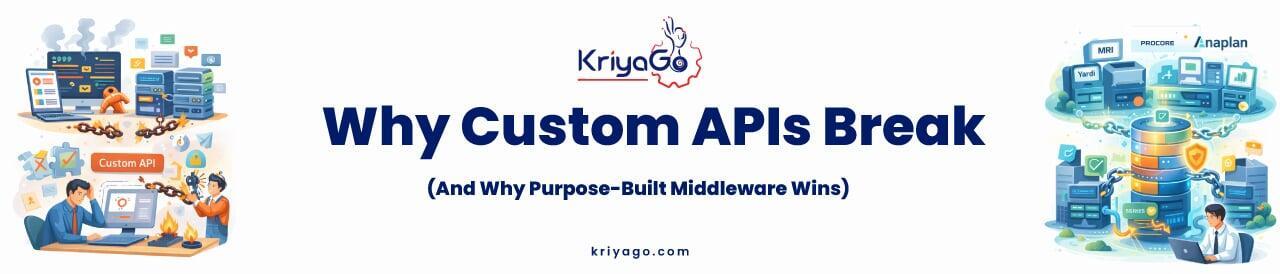
Your development team spent six months building a custom integration between your property management system and your financial planning platform. It worked beautifully until the next software update. Now that the API endpoints have changed, the data schemas no longer match, and your finance team is back to exporting CSVs while engineering works to resolve the connection issue.
This isn't bad engineering. It's the predictable outcome of custom integration in a world where software evolves faster than any internal team can keep up.
The Custom Integration Trap
Custom API integrations seem like the right solution. Your systems have APIs. Your team understands your business logic. Why pay for middleware when you can build exactly what you need?
The answer becomes clear about eighteen months later. The property management that works releases a significant update, and your custom code breaks. The engineer who built the integration moved on, and documenting tribal knowledge wasn't a priority. The "temporary" workarounds have become permanent fixtures. And every hour spent on integration maintenance is an hour not spent on strategic initiatives.
Gartner estimates that organizations spend up to 40% of their IT budgets maintaining existing integrations rather than building new capabilities. For real estate companies running dozens of system connections, custom integrations become a hidden tax that compounds year after year.
The API Availability Problem
Here's what most custom integration projects miss: having an API is only the beginning. Most real estate software platforms offer APIs that let you push data in or pull data out. But APIs alone don't solve the fundamental integration challenge of knowing when data has changed.
Consider a typical scenario. A lease amendment is processed in your property management system at 2:47 PM. Your financial planning model requires an update to generate accurate forecasts. With a standard API, you have two options: poll the source system constantly (expensive and inefficient) or run batch updates on a schedule (which means your downstream systems are continually working with stale data).
The industry is recognizing this gap. MRI Software's Agora platform introduces an event layer that signals when data changes within the MRI ecosystem a significant step toward real-time integration. But event-driven architecture requires middleware sophisticated enough to listen, interpret, and act on those signals across multiple platforms.
When Things Go Wrong: The True Test of Integration
Building an integration that works when everything is running smoothly is the easy part. The hard part, and where custom solutions typically fail, is handling what happens when things break.
What happens when the source system goes offline during a data sync? Does your integration indicate which records were transferred successfully and which weren't? Can it resume from the point of failure, or does it need to restart the entire batch? What if the connection drops mid-transaction? Do you end up with partial data that corrupts downstream systems?
These aren't edge cases. In enterprise environments with multiple time zones, maintenance windows, and network variability, failures are routine. Purpose-built middleware handles them gracefully: transaction logging, checkpoint recovery, automatic retry logic, and alerting when human intervention is required. Custom integrations typically handle them with late-night phone calls and weekend debugging sessions.
Productized IP vs. Custom Code
The difference between custom integration and purpose-built middleware isn't just technical, it's economic. Custom code is a cost centre. Every hour of maintenance, every upgrade cycle, every failed sync drains resources. The code itself has no value beyond your organization.
Purpose-built middleware is productized intellectual property. It embodies years of learning about how real estate systems actually behave, the quirks in Yardi's API, the nuances of MRI's data model, and the specific transformations required for Anaplan or Procore integration. That knowledge compounds across every implementation, making the platform more robust and more valuable over time.
For technology investors evaluating the PropTech landscape, this distinction matters. Custom integration projects are services revenue low margins, hard to scale. Productized middleware with deep domain expertise generates recurring software revenue and offers defensible IP. Deloitte Ventures and similar technology-focused investors increasingly recognize that the integration layer in real estate technology represents significant untapped value.
The Maintainability Imperative
When Yardi releases Voyager 8, who updates your integration? When MRI adds new fields to its API, who ensures your data mappings still work? When Procore changes its webhook structure, who is responsible for rewriting the listeners?
With custom code, the answer is your team assuming the original developers are still available and the documentation exists. With purpose-built middleware, the answer is the platform vendor, whose entire business depends on staying current with the real estate technology ecosystem. Updates happen automatically. The platform absorbs breaking changes. Your team focuses on using the integration rather than maintaining it.
Building for Scale
At KriyaGo, we've invested years building the integration infrastructure that real estate organizations need, not as custom projects, but as productized intellectual property. Our platform includes over 120 proprietary integration assets covering the major real estate ERP systems, financial planning platforms, and construction management tools. We handle event listening, failure recovery, version compatibility, and ongoing maintenance.
We've learned what breaks and why. We've built the resilience that only comes from managing thousands of integration touchpoints across diverse client environments. And we've packaged that knowledge into scalable software across properties, platforms, and organizations.
Custom APIs will always break. The question is whether you're building infrastructure to absorb that complexity or absorbing it yourself, one incident at a time.
Ready to move beyond custom integration?
See how KriyaGo's productized middleware platform connects your real estate technology stack. Request a demo to explore our integration solutions.