

Architecting the Real Estate Medallion Lakehouse: Progressive Path to Gold for Yardi, Procore, and MRI PMX Environments
A Deep-Dive Engineering Guide on Extracting, Normalizing, and Unifying Property ERP Data via MRI MIX APIs, Procore Delta Share, and Yardi Replication for Enterprise Business Intelligence
Executive Summary: The Real Estate ERP Data Bottleneck
In commercial real estate, property asset management, and enterprise data center development, data volume is rarely the primary challenge. The real obstacle lies in structural schema fragmentation across proprietary real estate software. Enterprise platforms such as Yardi Voyager (7s, 8, Elevate), Procore (Project Execution & Cost/Financial), MRI Software PMX (Property Management X), and Primavera P6 store critical leasing, financial, and construction metrics in isolated database silos with regional schema variations.
When property asset managers attempt to centralize this information, they encounter significant friction: standard batch ETL scripts take 7.5+ hours to process thousands of database tables, frequently failing due to database lock contention. Furthermore, traditional lakehouse projects operate as 'all-or-nothing' waterfalls, forcing business leaders to wait 6 to 9 months before receiving trusted reports.
This guide demonstrates how leading real estate enterprise architectures overcome these challenges by implementing a Progressive Medallion Data Lakehouse (Bronze, Silver, Gold). By deploying a 'Path to Gold' strategy, business teams start deriving actionable intelligence from Bronze within weeks, while establishing a unified DNA crosswalk key (e.g., Global Project ID) that links capital costs across Procore, Yardi, and MRI PMX via open API standards like MRI Information Exchange (MIX).
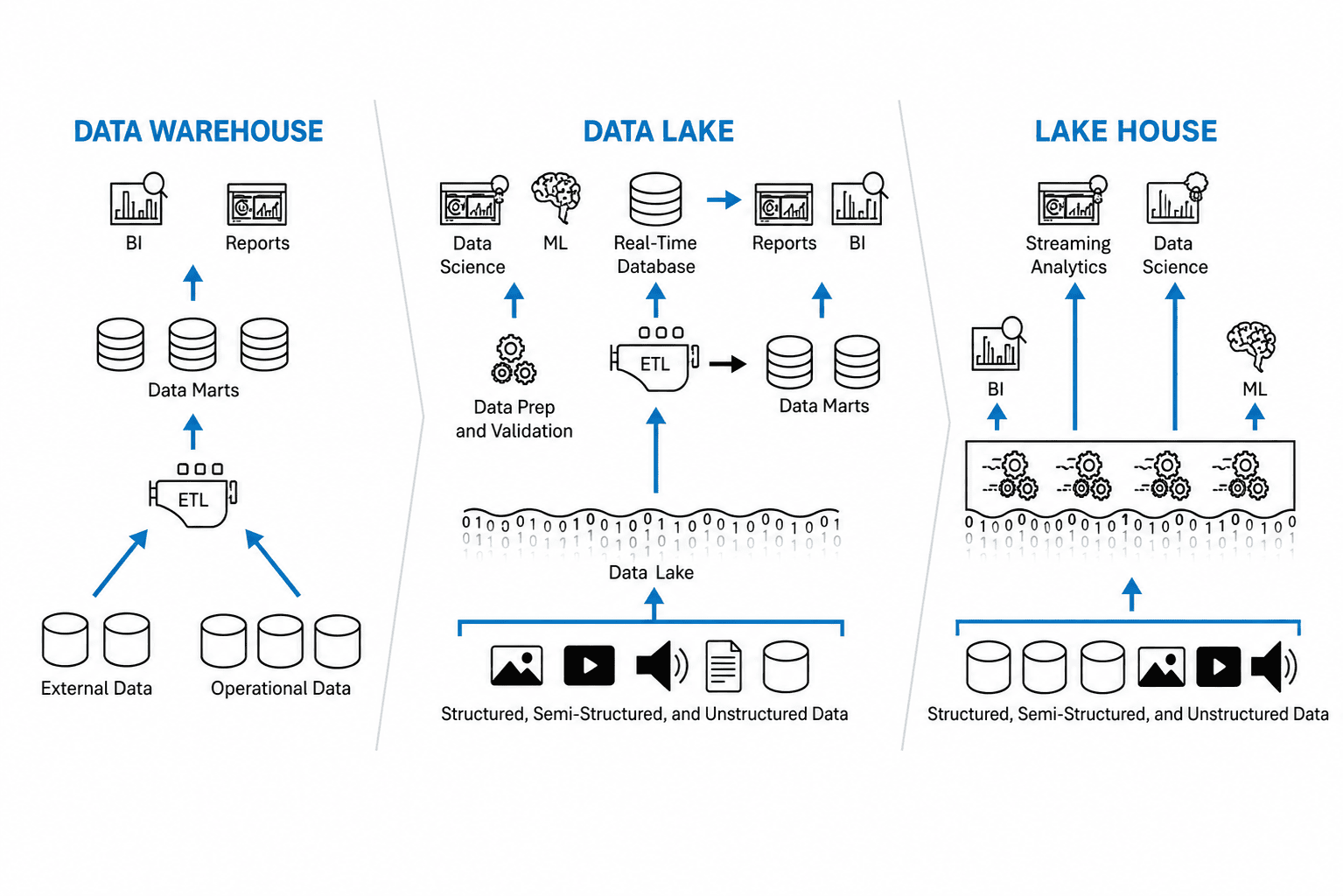
What is the Medallion Data Lake Architecture in Real Estate Software?
The Medallion Architecture is a structured data design pattern that refines raw operational payloads into certified business metrics across three distinct tiers: Bronze (Raw Ingestion), Silver (Cleaned and Conformed), and Gold (Curated Business Aggregations).
In enterprise real estate environments, enforcing this separation allows organizations to maintain complete historical auditability across multi-region ERP deployments without placing extra query load on live transactional databases.
1. The Bronze Layer: Raw Ingestion across Yardi, Procore, and MRI PMX
The Bronze layer ingests change streams, database dumps, and API payloads directly from real estate software
in their native formats without schema alteration.
Key Attribute:
Append-only immutable storage in cloud repositories (e.g., Azure OneLake, AWS S3) recording full transactional history.
Data Format:
Raw JSON API payloads from MRI MIX APIs (~1,000+ available endpoint surfaces), Delta Share Parquet CDC streams from Procore (~1,221 gross objects), and Yardi DB replication feeds.
Primary Value:
Instant visibility. Allows business teams to see landed raw data in tools like Power BI within days, replacing manual Excel exports immediately.
2. The Silver Layer: Normalizing Multi-ERP Schemas (Yardi, Procore, MRI PMX)
The Silver layer cleanses, deduplicates, and structurally normalizes raw Bronze payloads into an enterprise-wide canonical schema.
Key Transformations:
Normalizing multi-region Yardi Voyager (7s/8/Elevate), Procore Cost/PM, and MRI PMX Property Management tables into unified 3NF structures.
Data Structure:
Conformed relational 3NF tables and standardized Delta/Parquet tables.
Cross-System Linkage:
Establishes the DNA Backbone using crosswalk keys (e.g., Global Project ID / Unified Entity ID) to correlate construction commitments in Procore with GL actuals in Yardi and tenant lease ledgers in MRI PMX.
3. The Gold Layer: Board-Ready Certified Real Estate KPIs
The Gold layer transforms conformed Silver tables into highly curated, domain-specific star schemas and data marts optimized for executive analytics.
Data Architecture:
Certified KPIs such as Net Operating Income (NOI), Weighted Average Lease Expiry (WALE), Same-Store Revenue Growth,
and Committed vs. Actual Capital Cost.
Governance & Trust:
Sub-second query performance with confidence scores and named business stewards for every metric.
Primary Users:
C-suite executives, asset managers, and AI Data Agents searching for certified operational metrics.
Summary Comparison of Real Estate Medallion Lakehouse Layers
Layer | Quality & State | Real Estate Software Formats | Value Unlocked | Primary Consumer |
Bronze | Raw, as-landed, source-native | Yardi DB, Procore Delta Share, MRI MIX API JSON | SEE IT: Data landed in days; stops manual exports | Data Engineers, Audit Teams |
Silver | Cleansed, validated, conformed | Canonical Delta/Parquet tables, 3NF Star | TRUST IT: Cross-system correlation (Procore ↔ Yardi ↔ MRI) | Data Analysts, Asset Ops |
Gold | Business-ready, certified KPIs | Dimensional Star Schemas, Data Marts | CERTIFY IT: Board-ready metrics with named stewards | C-Suite, BI Tools, AI Agents |
How Do You Extract and Stream Data from Yardi, Procore, and MRI PMX?
Extracting data from enterprise real estate software requires choosing the optimal technical ingestion surface for each target platform to avoid rate limiting and transactional locks.
1. MRI Software Ingestion Mechanics: Harnessing MRI PMX & MIX APIs
MRI Software’s Property Management X (PMX) solution houses vital commercial leasing, tenant billing, and accounting ledgers. To extract required data without executing risky database backup moves or direct SQL locks on production servers, enterprise architectures leverage the MRI Information Exchange (MIX).
Ecosystem Scale:
MIX provides an open, secure ecosystem featuring over 1,000 unique partner-built and native APIs using industry-standard REST and Web API conventions.
API Extraction Strategy:
High-throughput micro-batch API ingestion built over industry-standard protocols, allowing seamless continuous extraction of tenant ledgers, property master records, and GL entries into the Bronze lakehouse tier.
Custom API Extensibility:
Using the MIX toolkit, custom endpoint wrappers can be built for proprietary in-house modules or specialized custom fields, guaranteeing EULA compliance and data integrity.
2. Procore Ingestion Surfaces (Analytics 2.0 Cloud Connector)
With Procore's Analytics 1.0 Data Extract retired in June 2026, modern lakehouse architectures standardize on Procore Analytics 2.0 via
Delta Share Cloud Connectors.
Delta Share Cloud Connector:
Governed, warehouse-grade table feeds streamed directly into Bronze storage over Delta Share.
Procore REST API:
Handles object-level pulls, rate-limit governance, and pagination for custom fields not exposed in bulk feeds.
3. Yardi Ingestion Mechanics (Voyager 7s/8, Elevate)
Yardi enterprise environments encompass ~2,816 gross tables across Commercial Core (GL, AP, AR, Property), Construction Manager, VendorCafe, and PayScan. High-efficiency pipelines target the ~550 de-duplicated, business-relevant entities using Yardi Replicate, REST APIs, and InterfaceConnect ETL feeds.
ENGINEERING FIELD REPORT: Enterprise Real Estate Ingestion
Real-World ERP Benchmark: A global real estate asset manager operating across 450 commercial properties was running nightly ETL scripts taking 7.5 hours across Yardi, Procore, and MRI instances. By deploying lightweight Change Data Capture (CDC) pipelines and micro-batch MIX API connectors such as the middleware pipelines built into KriyaGo, ingestion latency dropped from 450 minutes to under 45 seconds without impacting live production ERP databases.
What is the 'Path to Gold'? Why You Shouldn't Wait for Gold to Get Value
Traditional enterprise data projects follow a long waterfall build: business teams wait months before receiving any trusted reports. The Progressive 'Path to Gold' framework flips this paradigm by releasing a usable business product at every layer of the Medallion architecture.
CORE ARCHITECTURAL CONCEPT: The Progressive Path
The Progressive Path Paradigm: 'You don't wait for Gold to get value.' The medallion is not a waterfall. Each layer ships a usable product to the business, so value is released in weeks, long before all source systems reach certified Gold status.
The 5-Step Progressive Implementation Timeline
Weeks 1–3:Step 1
Land It (Bronze, Weeks 1–3): Ingest raw streams from Procore, Yardi, and MRI PMX (via MIX APIs) into OneLake. Business teams get immediate visibility in Power BI over raw data, baselining the 'Time to Gold' SLA.
Weeks 4–6:Step 2
Cleanse It (Silver, Weeks 4–6): Cleanse, validate, and enforce data quality gates. Operational reports become fully trustworthy for daily management.
Weeks 6–9:Step 3
Correlate It (DNA Backbone, Weeks 6–9): Crosswalk keys correlate disparate systems (e.g., Procore ↔ Yardi ↔ MRI PMX capital costs & lease ledgers) under a unified Global Project/Property ID.
Weeks 9+:Step 4
Certify It (Gold, Weeks 9+): Context-modeled Gold entities deliver board-ready certified KPIs with named finance stewards and confidence scoring.
Ongoing: Step 5
Serve & Govern It (Ongoing): Enable governed self-service, Microsoft Purview cataloging, row-level security (RLS), and AI Data Agent integration.
How Do You Resolve Capital Cost Overlaps Between Procore, Yardi, and MRI?
In construction asset management, capital-cost financing data is maintained across Procore (Cost & Financial Mgmt: Budgets, Commitments, Change Orders), Yardi (Construction Manager), and MRI PMX (Job Costing & GL). This multi-system footprint creates conflicting versions of truth.
A robust real estate data architecture resolves this prior to Gold modeling by establishing an explicit System of Record rule or implementing bi-directional integration with automated reconciliation rules.
The Multi-System Pilot Win: Procore ↔ Yardi ↔ MRI PMX View
The DNA Backbone crosswalk links Procore commitments with Yardi & MRI PMX financial actuals on a single Global Project ID:
Procore (Construction Commitments):
Budgets, change orders, and committed costs tracked directly from jobsite workflows.
Yardi & MRI PMX (Finance Actuals):
Purchase orders, journal vouchers, invoices, and paid GL actuals recorded in accounting.
Certified Gold KPI:
Committed (Procore) vs. Actual (Yardi/MRI) vs. Forecast delivered as a single certified KPI card with confidence scoring in weeks, rather than months.
How Do Query Engines and Signal Distribution Accelerate Real Estate Analytics?
Refining raw data into Gold tables is only effective if decision-makers receive actionable insights within their daily operational workflows.
1. Direct Lakehouse Querying (KriyaInsight)
Traditional analytics require exporting lakehouse data into external BI caches. Modern real estate platforms leverage embedded query engines such as KriyaInsight to execute vector processing directly over Gold Parquet and Delta Lake files. This delivers sub-second executive reporting while maintaining unified storage-level security.
2. Proactive Alerting & Event Distribution (KriyaSignal)
Rather than expecting asset managers to manually check dashboards, intelligent distribution layers such as KriyaSignal continuously monitor Gold metrics for variance exceptions. When a threshold is breached (e.g., tenant lease expiry within 90 days or capital expenditure variance >10%), contextual alerts and summary cards are automatically routed to Microsoft Teams, Slack, or email digests.
End-to-End Architectural Blueprint: Real Estate Lakehouse Ecosystem
The structured blueprint below details the full data lineage from source real estate applications through progressive lakehouse tiers to automated alerts:
- Yardi Voyager 7s/8 & Elevate (GL, AP, AR)
- Procore Construction (Project Exec & Cost)
- MRI PMX & MIX APIs, Primavera P6, Salesforce
- MRI MIX APIs (1,000+ REST endpoints)
- Procore Analytics 2.0 (Delta Share)
- Yardi Replicate DB & CDC connectors (KriyaGo)
- Bronze: Append-only raw JSON/Parquet
- Silver: Normalized 3NF + DNA Crosswalk
- Gold: Certified Star-Schema KPIs
- Native SQL & Vector Execution (KriyaInsight)
- Power BI & Microsoft Fabric integration
- Sub-second executive dashboards
- Threshold variance alerting (KriyaSignal)
- MS Teams & Slack proactive push feeds
- AI Fabric Data Agents over certified Gold
Frequently Asked Questions (FAQ)
Conclusion: Establishing Domain Authority in Real Estate ERP Data
Architecting a modern Medallion Data Lakehouse for real estate software is a strategic initiative that transforms fragmented operational records into certified enterprise assets. By implementing a progressive 'Path to Gold' framework, leveraging MRI MIX APIs alongside Procore Delta Share and Yardi replication, and deploying direct lakehouse analytics with active signal distribution, real estate organizations establish a scalable foundationfor AI-ready intelligence.