The hospitality industry has finally turned the corner. After losing $21 billion in revenue during the pandemic's darkest months, U.S. hotels now support 2.15 million direct employees and generate over $750 billion in annual guest spending. The recovery is real, but it's exposed to a technology problem that was easy to ignore when survival was the priority.
The Fragmented Hospitality Tech Stack
Oracle Opera has become the industry standard for property management, handling reservations, guest profiles, housekeeping, and front-desk operations for hotels worldwide. The Oracle Hospitality Integration Platform (OHIP) connects Opera to hundreds of partner applications for everything from payment processing to guest messaging.
Meanwhile, M3 has established itself as the leading hotel accounting platform, serving over 9,000 properties across North America. Built by hoteliers for hoteliers, M3 integrates with 60+ PMS, POS, and payroll systems and recently attracted a majority investment from Blackstone, signalling the platform's strategic importance to hospitality finance.
But here's the challenge: as hotel ownership structures grow more sophisticated, property-level accounting in M3 increasingly needs to flow into enterprise financial platforms like Yardi Voyager for investment management, fund accounting, and procure-to-pay processing. Real estate investment trusts, private equity funds, and institutional owners require consolidated reporting across their entire portfolios hotels, commercial properties, and residential assets alike.
Guest Experience Data Trapped in Opera
Oracle Opera captures wealthy operational data. Guest preferences. Spending patterns across rooms, restaurants, and amenities. Occupancy trends by segment: leisure, corporate, group. Revenue per available room broke down by channel, rate code, and booking source.
This data is gold for understanding property performance. But getting it into financial systems requires either manual extraction, CSV exports, spreadsheet manipulation, re-keying or complex custom integrations that break with every Opera Cloud update. The Oracle documentation notes that Opera provides "export functionality to more than 100 back-office systems," but export functionality and seamless integration are distinct.
PwC's Hospitality Directions report emphasizes that in an environment where operating costs outpace revenue growth, "identifying new revenue streams becomes paramount." But you can't optimize what you can't measure, and you can't measure what's trapped in disconnected systems.
When Hotel Accounting Meets Investment Management
M3 excels at hotel-specific accounting USALI-compliant chart of accounts, daily revenue posting from PMS systems, labor management, and operational reporting that hotel GMs actually use. For standalone properties or management companies that focus purely on operations, it's an ideal solution.
But ownership groups with mixed portfolios face a different reality. Yardi's Investment Suite handles fund accounting, investor reporting, debt management, and capital call processing across all asset classes. When REIT owns hotels alongside office buildings and multifamily properties, it needs consolidated financials on a single platform, not separate systems for each asset type.
The integration challenge is substantial. M3's hospitality-specific data structures don't map directly to Yardi's property management schemas. Chart of accounts translations, entity hierarchies, and reporting period alignments all require careful configuration. And the data needs to flow in both directions, operating results from M3 to Yardi for consolidation, and vendor payments and capital expenditures from Yardi's procure-to-pay suite back to property-level records.
Building the Complete Financial Picture
The hospitality recovery has shifted focus from survival to optimization. According to the American Hotel & Lodging Association's 2025 State of the Industry Report, as year-over-year occupancy rates stabilize and RevPAR growth flattens, "cost-conscious behaviour remains important, but identifying new revenue streams becomes paramount."
That optimization requires visibility into how guest experience investments translate into financial outcomes, how operational metrics drive NOI, and how individual property performance contributes to portfolio returns. It requires data flowing seamlessly from Opera's front desk through M3's accounting engine into Yardi's investment reporting.
Purpose-built middleware makes this possible. Rather than custom integration projects that consume IT resources and break with every software update, productized connectors handle the data transformation, validation, and synchronization that keep hospitality systems aligned with enterprise finance.
Connecting the Hospitality Tech Stack
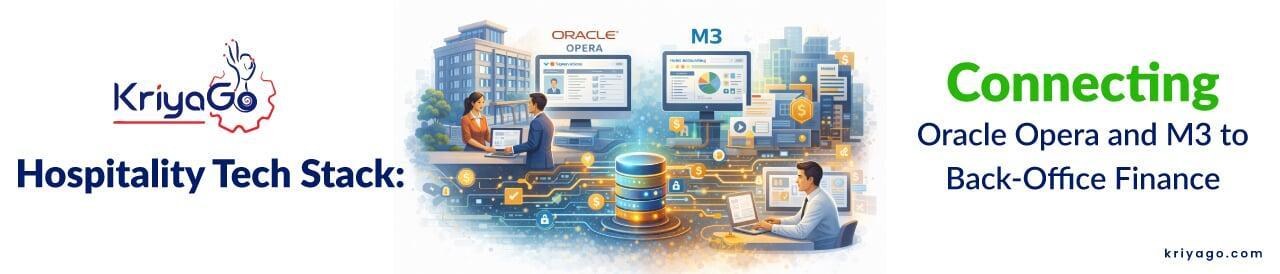
At KriyaGo, we build the integration infrastructure that connects hospitality operations in enterprise finance. Our Connect 360 platform bridges Oracle Opera, M3 Accounting, Yardi Voyager, and MRI Software, handling the data mappings, transformation logic, and synchronization workflows that enable multi-system environments.
With over 120 proprietary integration assets purpose-built for real estate and hospitality, we understand both the operational language of hotel management and the financial language of investment reporting. We automatically translate between them, so your teams can focus on running properties and serving guests, not reconciling spreadsheets.
The hospitality industry has recovered. Now it's time for hospitality technology to catch up.Ready to connect your hospitality tech stack?
See how KriyaGo bridges M3, and Yardi into a unified financial ecosystem. Request a demo to explore our hospitality integration solutions.