
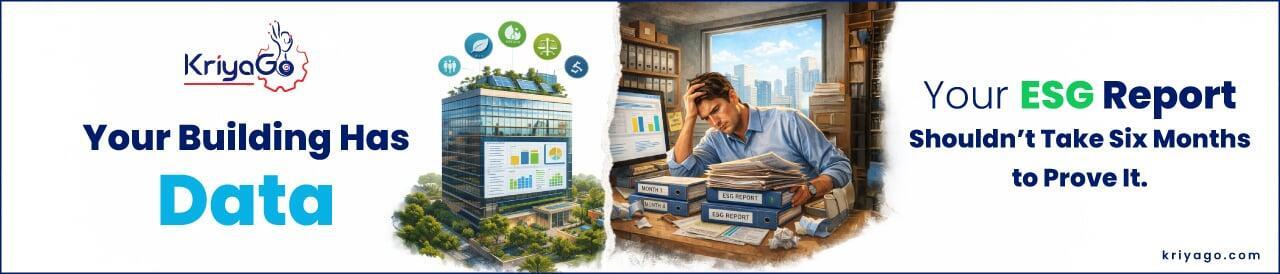
ESG Reporting Automation: Turning Sustainability Data Into Auditable Compliance
The real estate industry is responsible for roughly 37% of global CO₂ emissions. Everyone knows this. Almost nobody can prove what they’re doing about it.
That’s the gap ESG reporting is supposed to close. But for most commercial real estate firms, sustainability reporting in 2026 still looks like this: a compliance analyst spends weeks pulling utility bills from dozens of property managers, manually entering kilowatt-hours into spreadsheets, chasing down waste hauling invoices, and stitching together a report that’s outdated by the time the auditor sees it.
The problem isn’t commitment. Deloitte’s 2025 CRE Outlook found that 76% of respondents plan to undertake significant energy retrofits in the next 12 to 18 months. The EU’s Omnibus Simplification Package is recalibrating CSRD scope, but the direction is clear ESG disclosure is tightening, not loosening. In the UK, ESOS Phase 4 will make energy data public from 2026. In North America, GRESB scores increasingly determine whether institutional capital even considers your fund.
The intent is there. The infrastructure to deliver on it is not in place.
Why ESG Reporting Breaks in Real Estate
The fundamental challenge is fragmentation. A typical mid-market portfolio runs on three to five disconnected systems: a property management ERP like Yardi or MRI for financials, a separate building management system (BMS) for HVAC and lighting, utility provider portals for energy and water consumption, third-party waste management vendors, and perhaps an IoT sensor layer for newer buildings. None of these systems talk to each other natively.
The result is a reporting process built on manual extraction, copy-paste aggregation, and unit conversions done in spreadsheets. In this process, a single transposed digit in an energy invoice can cascade into a material misstatement on your GRESB submission. When auditors ask for data lineage (“Show me where this carbon number came from”), the answer is often a person’s name, not a system.
When auditors ask for data lineage, the answer is often a person’s name, not a system. |
This isn’t sustainable in any sense of the word.
What Automated ESG Reporting Actually Looks Like
Automation doesn’t mean a dashboard that displays last quarter’s energy data in a green-tinted chart. It means a connected pipeline in which sustainability metrics flow from source systems into auditable reports without manual intervention at each step.
Here’s what that pipeline requires:
An integration layer that connects disparate sources
Utility feeds, BMS data, IoT sensors, waste management APIs, and your property ERP need a common middleware backbone. At KriyaGo, KriyaSync provides 120+ pre-built connectors that normalize data formats, currencies, measurement units, and reporting calendars across systems and geographies. Our Connect 360 solution extends this to cross-border portfolios where date formats, chart-of-accounts structures, and regulatory frameworks vary by country.
Automated data validation and anomaly detection
Raw utility data includes messy estimated reads, billing period overlaps, and unit errors. Before any ESG metric is reported, it undergoes automated quality checks: Is this consumption figure within the expected range for this building type and season? Did the meter reading gap suggest an estimation rather than an actual read? KriyaInsight applies AI-powered anomaly detection to flag outliers before they contaminate your compliance submissions.
Immutable audit trails
Every data point in your ESG report needs a traceable lineage: source system, extraction timestamp, transformation rules applied, and any manual overrides. This is the difference between a report and evidence. When your GRESB assessor or CSRD auditor asks how a Scope 2 emissions figure was derived, the system should answer that question, not a person scrambling through email attachments.
The Financial Case: ESG as Asset Value, Not Cost
This isn’t just about compliance risk. EY’s modeling shows that green-certified buildings experience a 2.5% to 5.0% increase in effective gross revenue from lower vacancy and collection losses, a 2.5% to 5.0% reduction in common area maintenance costs, and an overall 10% to 21% uplift in market value compared to non-certified equivalents. A recent industry survey found that 90% of asset managers believe integrating ESG technology improves investor returns.
The math is straightforward: the cost of automating your sustainability data pipeline is a fraction of the asset value uplift it protects. The firms that treat ESG reporting as an operational capability, not an annual compliance fire drill, l are the ones capturing that premium.
Where to Start
You don’t need to automate everything at once. The highest-ROI starting point for most CRE firms is energy and emissions data — it’s the most heavily scrutinized metric across GRESB, CSRD, and ISSB frameworks, and it’s where manual processes introduce the most error.
Connect your utility feeds and BMS data to your property management ERP through a middleware layer. Apply automated validation rules. Generate Scope 1 and Scope 2 emissions calculations from verified source data rather than estimated spreadsheets. Build the audit trail once, and every subsequent reporting cycle becomes faster, cheaper, and more defensible.
The buildings already have the data. The question is whether your systems can generate evidence before the auditor asks. |
KriyaGo’s integration and intelligence platform gives real estate operators the connective tissue between where sustainability data lives and where compliance demands it. Because in 2026, the firms that can prove their ESG performance not just promise it are the ones that win capital, tenants, and long-term value.
About KriyaGo
KriyaGo is a PropTech platform that powers integration, automation, and AI-driven intelligence for real estate operators, investment firms, and property managers across North America, Australia, and the Asia-Pacific. Explore our solutions at kriyago.com/our-products