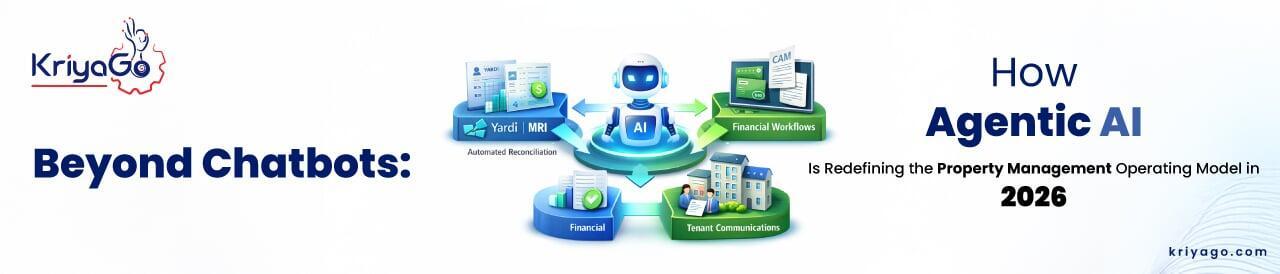
What is Agentic AI in property management? Agentic AI refers to autonomous, goal-driven artificial intelligence systems that execute multi-step workflows across connected platforms without requiring step-by-step human prompting. Unlike Generative AI, which responds to inputs by producing content (text, summaries, drafts), Agentic AI pursues objectives: it plans, decides, acts, monitors outcomes, and self-corrects across systems like Yardi, MRI Software, and connected financial platforms. In property management, this means an AI system that not only generates a CAM reconciliation report but also runs the reconciliation, posts the adjustments, drafts the tenant letters, and routes exceptions for human review.
For most commercial real estate organizations, the last five years of AI adoption have produced the same outcome: useful tools sitting adjacent to core workflows. Lease abstractions generated by large language models that still require manual entry into Voyager. Chatbots that answer tenant queries but cannot update a work order. Dashboards that surface insights that nobody has time to act on. The intelligence was there. The execution was not.
That is the precise gap that Agentic AI is designed to close. Research published by McKinsey in March 2026 identifies a labor productivity opportunity of $430 billion to $550 billion annually across real estate, construction, and development through AI automation of knowledge work. The firms that capture that value, the research makes clear, will not be those that pilot the most AI tools. They will be those who redesign entire operational domains to embed autonomous agents directly into their core systems.
This is no longer a future-state scenario. Global PropTech funding reached $16.7 billion in 2025, a 67.9% year-on-year increase, with capital concentrating heavily in AI-native platforms built around execution, not just assistance. Agentic AI is expected to reach mainstream adoption in commercial real estate between 2026 and 2027.
Generative AI vs. Agentic AI: Why the Distinction Matters for Your Operating Model
The confusion between these two terms is not semantic. It has direct consequences for how real estate technology investments are evaluated and deployed.
Generative AI (think ChatGPT, Copilot, or an AI lease abstraction tool) operates in a request-response pattern. A human prompts it; it produces output. The human then decides what to do with that output. The model does not hold state, does not connect to downstream systems, and does not execute any workflow. It is a highly capable tool that still requires human involvement at every step.
Agentic AI operates differently. As defined by ProptechOS, an agentic system combines data, rules, and learning agents to monitor conditions, make decisions, and execute tasks across systems continuously and reliably. It is given a goal, not a prompt. It plans a sequence of actions to achieve that goal, executes them across connected platforms, monitors outcomes, handles exceptions, and escalates only when human judgment is genuinely required.
In practical property management terms, a Generative AI tool drafts a CAM variance explanation. An Agentic AI system runs the CAM reconciliation from start to finish, pulling actuals from Yardi or MRI, comparing to budgeted recoveries, identifying variance thresholds, posting adjustments within GL controls, generating tenant-specific reconciliation letters, and routing disputes to the accounting team as structured exceptions. The human reviews the exceptions. The agent handles everything else.
2026 Benchmark: Analysts estimate Agentic AI could automate up to 70% of tasks currently performed by junior property management staff by 2027, including routine financial processing, compliance checks, and tenant communications. (Blott AI in Real Estate Report, 2026)
The 5 Maturity Stages of AI Adoption in Real Estate
Most real estate organizations are not starting from zero. They have implemented some form of AI or automation. Understanding where they sit on the maturity curve determines the next investment.
Stage 1 — Reactive Automation
Rule-based scripts and scheduled tasks handle isolated, repetitive actions: auto-posting rent charges, generating standard reports on a schedule, and routing inbound maintenance requests by category. The system does exactly what it is told, when it is told. No reasoning, no adaptation. This describes the majority of property management automation in place today.
Stage 2 — Assisted Intelligence
Generative AI is layered onto existing workflows: AI-assisted lease abstraction, natural-language Q&A against portfolio data, and AI-drafted tenant communications. As McKinsey observes, this is where most real estate organizations currently sit, launching sensible AI experiments that help people be more effective but rarely transform how work gets done inside core systems.
Stage 3 — Connected Workflow Automation
Integration platforms connect Yardi, MRI, or other property management systems with downstream tools via APIs and data pipelines. Workflow triggers automatically move data between systems. Financial data flows without manual export and re-import. This eliminates significant data-entry labor and improves data accuracy, but still requires human decision-making at transition points.
Stage 4 — Autonomous Agents (Agentic AI)
AI agents are embedded within operational domains, such as CAM reconciliation, accounts payable, tenant onboarding, maintenance dispatch and execute complete workflow sequences with defined objectives, contextual decision rules, and human-in-the-loop escalation for genuine exceptions. According to ICSC's January 2026 PropTech analysis, potential agentic AI applications are described by KPMG as "mind-boggling", with the resulting end-to-end automation capable of disrupting entire organizational value chains. This is where early adopter organizations are operating now.
Stage 5 — The Property Operating System (PropOS)
The emerging endpoint: a coordinated layer of specialized agents, digital twins, and data infrastructure that continuously optimizes portfolio operations what PwC and ULI describe as a "property operating system" in their Emerging Trends in Real Estate 2026 report. Buildings manage themselves. Portfolios self-report. Humans provide strategy, governance, and relationship management.
Where is your organization? Most commercial property managers are currently at Stage 2 or early Stage 3. The organizations building competitive advantage in 2026 are moving to Stage 4. The transition from Stage 3 to Stage 4 is primarily an integration and workflow-architecture challenge, not a machine-learning challenge. The question is not whether the AI is powerful enough. It is whether your system connectivity is deep enough for agents to act.
Use Case: Autonomous CAM Reconciliation in Yardi and MRI Software
Common Area Maintenance reconciliation is one of the most labor-intensive processes in commercial property management. For a portfolio of 30 or more properties, each with multiple tenants on varying lease structures, CAM reconciliation consumes hundreds of accounting hours annually, pulling actuals, comparing to budgeted recoveries, calculating pro-rata shares, identifying cap exclusions, preparing variance explanations, and generating tenant-specific letters.
It is also the process most exposed to human error at scale. As reconciliation specialists at Quantratech note, the structural inefficiency is not a skills problem; it is a volume problem. A portfolio running bank and CAM reconciliations across 50 or more accounts is executing the same logical sequence hundreds of times per close cycle.
An Agentic AI approach to CAM reconciliation changes the operating model at every step:
• Data ingestion: The agent pulls actual expense data from the Yardi or MRI general ledger, cost pool allocations, and lease-specific recovery parameters automatically on a configurable schedule aligned to the close cycle.
• Variance analysis: The agent compares actual recoverable expenses against estimated CAM charges, calculates per-tenant pro-rata shares based on lease terms, applies exclusions and caps as defined in the lease, and identifies variances exceeding defined thresholds.
• Posting and adjustment: Within GL controls and approval workflows, the agent posts reconciliation charges or credits back to Yardi or MRI, updating tenant accounts without manual intervention for clean reconciliations.
• Letter generation: Tenant-specific reconciliation letters, including calculation detail, balance due or owed, and supporting schedules, are generated automatically, formatted to portfolio standards.
• Exception routing: Reconciliations that fall outside defined thresholds, involve lease disputes, or require judgment calls are flagged with structured context and routed to the accounting team for review, not left to be discovered during close.
The result is not that accountants are eliminated from CAM reconciliation. It is that their time is concentrated on the 10–15% of reconciliations that genuinely require human judgment, rather than being consumed by the mechanical execution of the other 85–90%.
This workflow architecture connecting property management systems, financial controls, tenant communication platforms, and exception management queues into a single coordinated agent workflow is precisely the kind of integration layer that KriyaFlow is designed to enable. Rather than building point-to-point connections between Yardi and external tools, a workflow and integration platform creates the orchestration infrastructure that allows agents to operate across systems with full data context, audit trails, and human override capability at every node.
Task Automation vs. Autonomous Agents: What Actually Changes
Understanding the operational difference between conventional automation and Agentic AI is the foundation of building a credible business case for AI investment in 2026.
Dimension | Task Automation | Agentic AI Agents |
Trigger | Rule-based, scheduled | Goal-driven, event-aware |
Scope | Single, defined task | Multi-step workflow end-to-end |
Decision-making | Pre-programmed only | Contextual reasoning in real time |
Human role | Define rules upfront | Set objectives, review exceptions |
System integration | Point-to-point | Orchestrated across multiple systems |
Adaptability | Low — requires reprogramming | High - adjusts to new conditions |
Error handling | Stops or fails silently | Flags exceptions, routes for review |
PropTech example | Auto-post rent charge on 1st | End-to-end CAM reconciliation with tenant letters |
The critical column in this table is Error handling. Conventional automation stops or fails silently when it encounters an unexpected condition. In a financial context, CAM reconciliation, AP matching, and bank reconciliation silent failure is not neutral outcome. It is an audit risk. Agentic systems are designed to flag and escalate exceptions with context, giving human reviewers the information they need to resolve the issue rather than discovering it during an audit.
Data Governance, Security, and the “Hallucination” Risk in Financial Reporting
Every legitimate evaluation of Agentic AI for financial workflows must address three concerns: data security, governance and auditability, and the accuracy risks associated with generative AI models. As noted by PropTech analysts covering the UAE market for 2026, "data governance and privacy must be foundational and not an afterthought" in any agentic architecture deployed over financial and lease data.
On Data Security
Agentic AI deployed for financial workflows in property management should operate within the organization's existing identity and access management boundaries. Agents should inherit role-based permissions from the underlying system (Yardi, MRI), should not have write access beyond what the workflow requires at each step, and all actions should be logged with full audit trails that are accessible to compliance teams. Architectures that route financial data through third-party large language model APIs without data-residency controls pose unacceptable risk to regulated portfolios.
On Governance and Auditability
Agentic systems designed for property management financial workflows should produce a structured log of every decision and action taken, with the data inputs that informed each decision. This is not optional for CAM reconciliation or AP processing; it is a baseline audit requirement. The human-in-the-loop escalation model (flagging exceptions rather than silently proceeding) is the governance mechanism, not a workaround for AI limitations.
On the Hallucination Risk
This concern is legitimate in generative AI contexts. A language model producing a CAM explanation letter that invents figures it was not given is a real risk. Agentic AI in financial workflows should not rely on language model generation for numerical accuracy. Calculations of pro-rata shares, GL balances, and variance amounts should be deterministic, derived directly from system data. Language model components should be limited to communication and explanation tasks (drafting letters, summarizing variances) and should always reference system-verified figures rather than generated ones. Well-architected agentic workflows separate the execution layer (deterministic, data-driven) from the communication layer (generative, human-reviewable) precisely to eliminate this risk from financial reporting.
The architecture question: Before adopting any Agentic AI solution for Yardi or MRI financial workflows, ask three questions: (1) Where does the agent get write permissions, and are they scoped to the minimum required? (2) What is the complete audit log of every agent action? (3) Which calculations are deterministic from system data vs. generated by a language model? Inability to answer all three clearly is a governance gap, not a technology limitation.
The Operating Model Shift: From AI Tools to AI Teammates
Inman's February 2026 analysis of Agentic AI at the real estate industry's largest conference captured the shift precisely: the question is no longer "What can AI do for us?" It is "Which workflows should we redesign so the software is allowed to do the work?"
For commercial property management organizations running Yardi or MRI Software, the answer to that question starts at the intersection of high-volume, rule-governed financial processes and connected system data. CAM reconciliation, bank reconciliation, AP invoice matching, tenant statement generation, and compliance reporting are the domains where Agentic AI delivers the fastest measurable return, not because they are the most intellectually complex, but because they are the most structurally repetitive and the most dependent on data accuracy at scale.
The transition from Stage 3 (connected workflow automation) to Stage 4 (autonomous agents) is not primarily a technology purchase decision. It is an integration architecture decision. The organizations that move fastest are those with a clear map of their system connectivity, defined data ownership across Yardi/MRI and adjacent platforms, and a workflow orchestration layer that gives agents the access, context, and audit infrastructure they need to operate reliably. KriyaFlow's workflow and integration platform is built specifically for that connectivity layer in PropTech environments, enabling organizations to move from fragmented automation to coordinated agentic operations without rebuilding their core systems.
The chatbot era of PropTech AI is over. The agentic era has begun. The organizations that understand the difference and act on it will define the operating standard for the next decade of commercial property management.
Frequently Asked Questions
What is the difference between Agentic AI and Generative AI in property management?
Generative AI (ChatGPT, Copilot, AI lease abstractors) produces output in response to a human prompt, a summary, a draft, or an answer. The human then decides what to do with it. Agentic AI is given a goal and autonomously executes multi-step workflows across connected systems, making decisions, routing exceptions, and completing tasks without step-by-step human prompting. In property management, the difference is between an AI that drafts a CAM letter and one that completes the entire CAM reconciliation.
Is Agentic AI ready for commercial real estate financial workflows in 2026?
Early adopters are already deploying agentic workflows for financial processing. McKinsey's March 2026 research documents active implementations across maintenance operations, tenant management, leasing, and financial reporting. The technology is production-ready; the primary variables are the quality of the integration architecture, the design of data governance, and the specificity of workflow definitions.
How does Agentic AI handle errors in CAM reconciliation or financial posting?
Well-designed agentic systems flag exceptions rather than proceeding silently or failing. Any reconciliation that falls outside defined thresholds, involves lease disputes, or requires human judgment is routed with full context to a review queue. The audit log captures every agent action, the data it uses, and the decision it makes providing the same documentation an accountant would produce manually at every step of the workflow.
What is the hallucination risk when using AI for financial reporting in Yardi or MRI?
The hallucination risk (a language model generating figures it was not given) applies to generative AI components, not to the deterministic calculation layer. In a properly architected agentic workflow for CAM reconciliation or AP matching, all numerical calculations are derived directly from verified system data in Yardi or MRI. Language model components are scoped only to communication tasks (drafting letters, explaining variances) and always reference confirmed system figures. Architectures that generate financial figures using language models are not appropriate for regulatory or audit-grade workflows.
What is KriyaFlow, and how does it support Agentic AI in property management?
KriyaFlow is KriyaGo's workflow automation and integration platform designed for PropTech environments. It provides the system connectivity layer API integrations, data orchestration, audit logging, and exception routing that enable agentic workflows to operate across Yardi, MRI, and connected financial, operational, and communication platforms. Rather than building custom point-to-point integrations for each workflow, KriyaFlow provides the integration infrastructure that agents need to act across systems with full data context and governance controls.
Sources:
• McKinsey — How Agentic AI Can Reshape Real Estate (Mar 2026)
• ICSC — Next Phase of PropTech: Agentic AI in 2026 (Jan 2026)
• Blott — AI in Real Estate 2026 Report
• Inman — What Is Agentic AI in Real Estate? (Feb 2026)
• ProptechOS — Agentic PropTech Platform
• PwC / ULI — Emerging Trends in Real Estate 2026
• Real Estate Solutionist — Agentic AI Operating Systems (Apr 2026)