
Why KriyaSync Wins the Real Estate Integration Race
Real estate companies face a critical choice: struggle with generic integration platforms that don't understand property management workflows, or settle for limited real estate tools that can't scale. KriyaSync delivers the best of both worlds—enterprise-grade integration capabilities purpose-built for real estate, at a fraction of the cost and complexity.
The $71 Billion Integration Problem
The PropTech market is exploding, projected to reach $71-179 billion by 2032. Yet 70% of property managers still struggle with fragmented systems, losing up to 30% in revenue due to integration challenges. Why? Because they're forced to choose between two failing approaches: generic enterprise platforms that cost $250,000+ annually and take 6-12 months to implement, or limited real estate tools that can't handle complex workflows.
Real estate companies managing billions in assets need something different. They need integration platforms that understand property hierarchies, lease abstractions, CAM reconciliations, and the complex dance between Yardi, MRI, Procore, and dozens of other specialized systems. Generic platforms like MuleSoft and Boomi weren't built for this reality.
Generic Platforms: Powerful but Impractical
The Enterprise Integration Giants Fall Short
MuleSoft, Boomi, and Zapier dominate the broader integration market, but they create more problems than they solve for real estate companies:
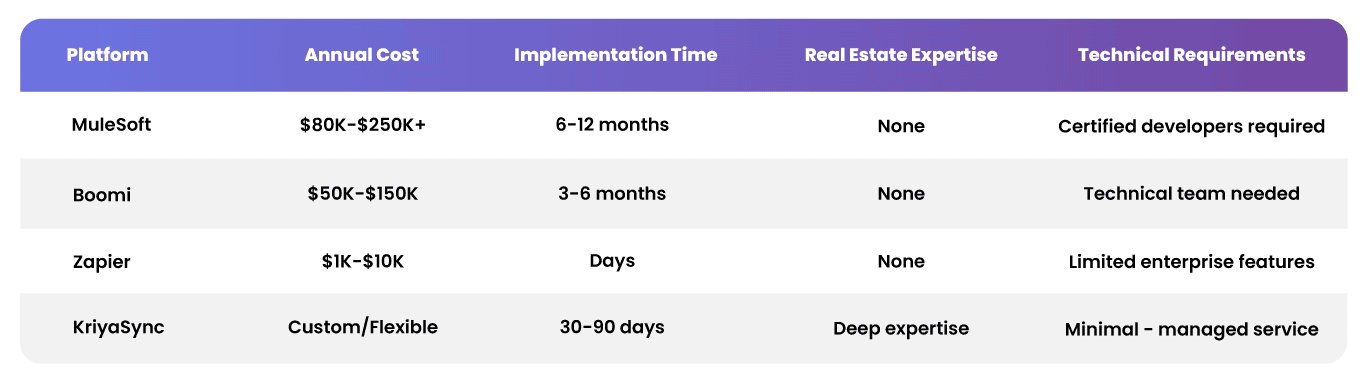
The fundamental problem? These platforms require extensive customization for every real estate workflow. Need to sync lease data between Yardi and your accounting system? That's months of custom development. Want to map different GL codes across properties? More custom code. The result: blown budgets, delayed launches, and frustrated teams.
Real Estate Solutions: Specialized but Limited
When Industry Focus Isn't Enough
Real estate-specific platforms like Cherre and CREx understand the industry but fall short in different ways:
Cherre excels at data aggregation with 3.3 billion
addresses in their knowledge graph, but their enterprise-only focus and one-way data flow model create gaps:
- Limited two-way synchronization capabilities
- Complex implementation requiring data scientists
- Enterprise pricing that excludes mid-market companies
- Rigid data models that don't support flexible object mapping
CREx Software targets asset management workflows
but lacks comprehensive integration capabilities:
- Narrow focus on property management systems only
- Limited scalability for enterprise deployments
- Missing critical financial system integrations
- No support for construction management platforms
KriyaSync: Built for Real Estate, Designed to Scale
The Complete Integration Solution
KriyaSync combines 25+ years of real estate technology expertise with modern integration capabilities to deliver what others can't:
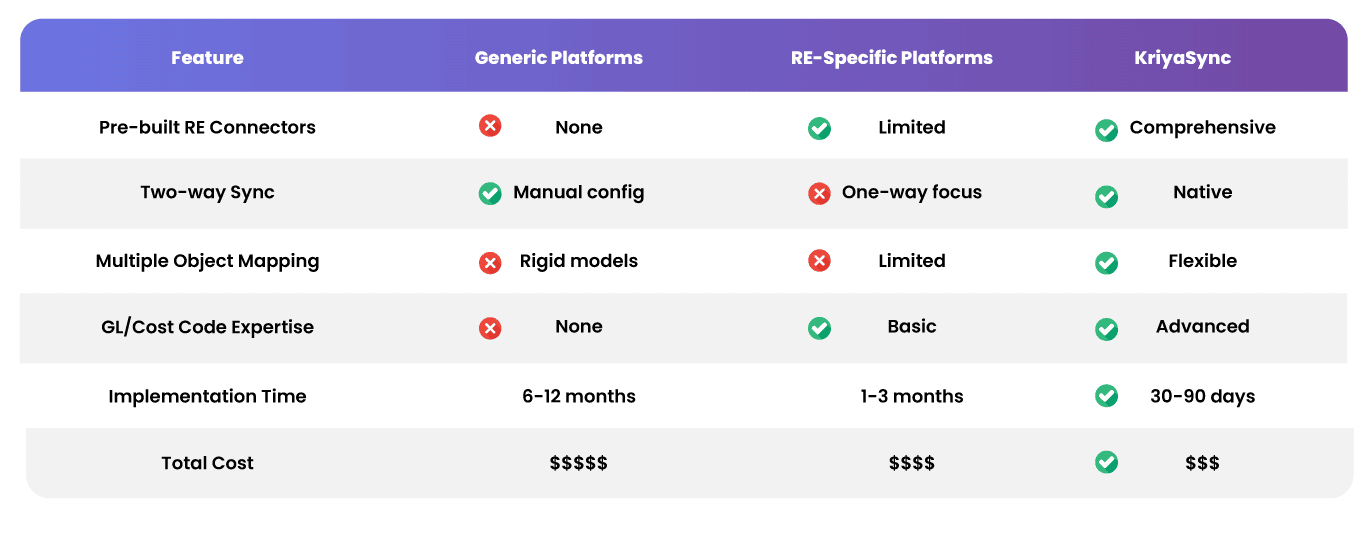
Four Unmatched Advantages
1. Real Estate DNA from Day One
Unlike generic platforms retrofitted for real estate, KriyaSync was explicitly built for property management workflows. Pre-built connectors for Yardi, MRI, RealPage, Procore, and SAP Concur mean you're operational in weeks, not months. Our team understands lease abstractions, CAM reconciliations, and property hierarchies—because that's all we do.
2. True Two-Way Integration
While Cherre focuses on data aggregation and generic platforms require complex configurations, KriyaSync delivers native bi-directional synchronization. Update a Job Budget in Yardi? It flows to your Procore system instantly. Approve an invoice in Concur? The GL coding maps perfectly to your property management system: no batch processing delays, no one-way limitations.
3. Flexible Object Mapping
Real estate companies need to map the same data differently across systems—different GL accounts for properties, varying cost codes for projects, and complex inter-company transactions. KriyaSync's multiple object mapping handles these scenarios elegantly, something rigid enterprise platforms and limited real estate tools can't match.
4. Proven at Scale
With 100+ Jones integrations processing 2.5 billion square feet of real estate, plus qualified marketplace status with both Procore and SAP Concur, KriyaSync has proven enterprise credibility. We're not a startup hoping to figure out real estate—we're the integration partner trusted by industry leaders like Jones.
The ROI Difference
Deployment Speed Comparison
Integration Timeline by Platform Type:
Generic Platforms (MuleSoft/Boomi):
6-12 months
Real Estate Platforms (Cherre/CREx):
1-3 months
30-90 days ⚡
Value Delivery Model
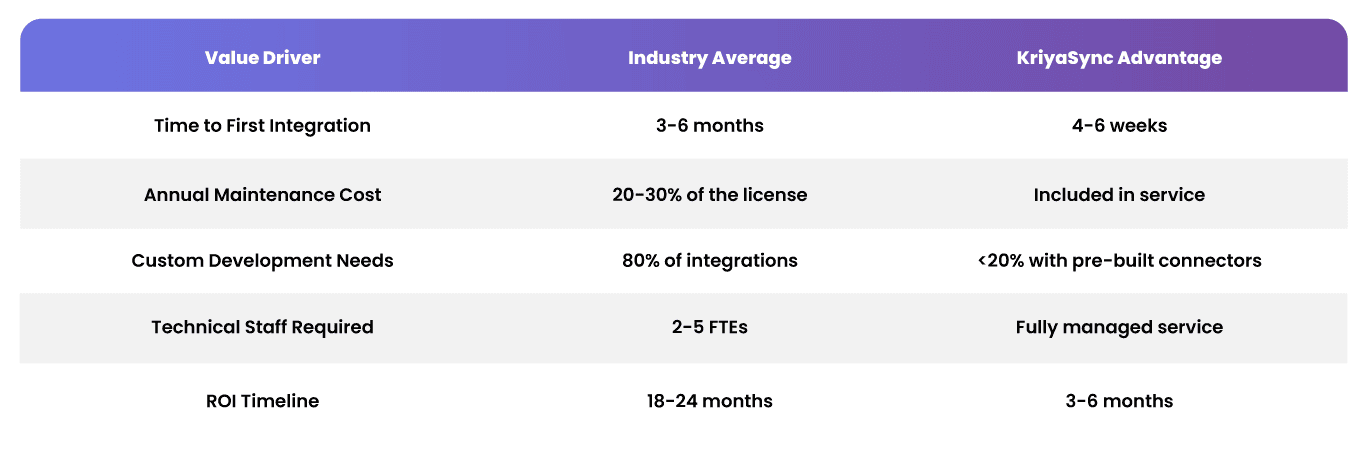
Real estate companies using KriyaSync report saving $130,000+ annually per property through automation, with some achieving 240% ROI within months. Compare that to generic platforms where companies often spend more on implementation than the platform itself, or limited real estate tools that can't deliver enterprise-scale automation.
Conclusion: Why Real Estate Leaders ChooseKriyaSync
In a market growing at 16% annually toward $179 billion by 2034, real estate companies can't afford integration platforms that hinder their growth. Generic solutions like MuleSoft and Boomi weren't built for the complexity of property management. Real estate platforms like Cherre and CREx solve part of the problem but create new limitations.
KriyaSync delivers what others can't: deep real estate expertise, proper two-way integration, flexible object mapping, and proven scale—all at a fraction of the cost and complexity of alternatives. With pre-built connectors for every central real estate platform and implementation measured in weeks, not months, KriyaSync helps property management companies capture the full value of their technology investments.
Ready to see why industry leaders trust KriyaSync?
Visit:
to schedule your integration assessment today