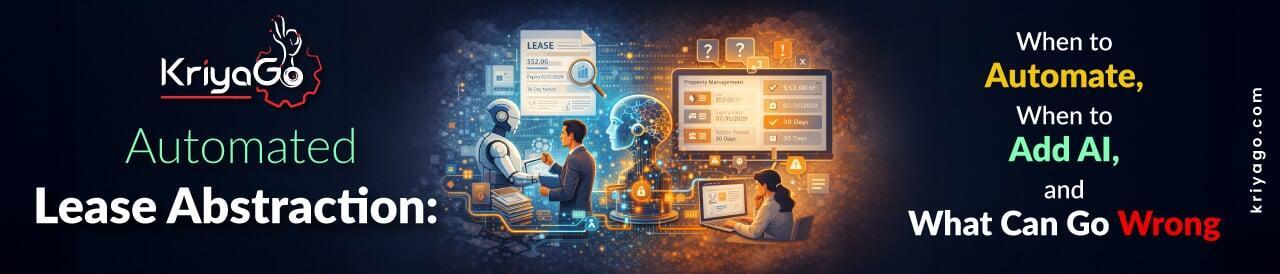
The promise is compelling: AI reads your leases, extracts the critical terms, and populates your property management system in minutes instead of hours. The reality is more nuanced. After working with real estate organizations across North America and Asia-Pacific on lease data integration, we've learned that successful automation isn't about throwing AI at the problem; it's about building the proper foundation first.
This guide walks through what actually works, what doesn't, and how to avoid the pitfalls that derail most lease abstraction automation projects.
Start with Process, Not Technology
The most common mistake in lease automation is jumping straight to AI without understanding the existing workflow. Before evaluating any technology, answer these questions: What field do you actually need abstracted? Where does the data need to go? Who validates it before it enters your system of records?
Many organizations discover they've been abstracting 200+ fields when only 40 are relevant to day-to-day operations. Others find that their abstraction template was designed for a different property management system than the one they use. Start by mapping your current process, identifying where data flows, and determining which fields drive business decisions versus which are "nice to have."
Success factor: Define your abstraction template based on downstream system requirements, Yardi, MRI, or whatever property management platform receives the data. Work backwards from the system fields to determine what needs to be extracted.
The Automation Foundation: What to Build Before AI
Automation and AI are not the same thing. Automation handles predictable, rule-based processes. AI handles variability and interpretation. Build the automation layer first.
Document Intake and Standardization
Create a consistent ingestion pipeline: how leases enter the system, how they're named, how they're stored. This seems basic, but inconsistent document handling creates chaos downstream. Establish naming conventions, folder structures, and version control before touching extraction technology.
Template Mapping
Different lease types require different abstraction templates. A ground lease has different critical terms than a retail lease with percentage rent clauses. Create template variants for your portfolio's lease types and automate document routing to the appropriate template based on lease classification.
Validation Rules
Before any data enters your property management system, automated validation should catch obvious errors: dates that don't make sense (a lease that expires before it starts), rent amounts outside normal ranges, and missing required fields. These rules don't require AI; they need clear business logic translated into automated checks.
When to Introduce AI and What Kind
AI adds value where variability defeats rule-based automation. In lease abstraction, this refers to three specific areas.
OCR for Legacy Documents
Optical Character Recognition converts scanned documents into machine-readable text. Modern OCR handles poor-quality scans, handwritten annotations, and degraded documents far better than systems from even five years ago. If your portfolio includes legacy leases from acquisition documents that are 20 or 30 years old, OCR is the starting point. Without reading the text, nothing else works.
NLP for Clause Interpretation
Natural Language Processing interprets legal language to extract meaning. This is where AI addresses the variability problem: one lease states "Tenant shall pay Base Rent," another states "Lessee's monthly payment obligation," and a third states "fixed minimum rent." NLP models trained in real estate language recognize these as equivalent concepts and extract the relevant figures.
Machine Learning for Pattern Recognition
ML models improve with exposure to more documents. They learn to recognize where specific clause types typically appear in a lease, what language patterns signal renewal options versus termination rights, and how different law firms structure similar provisions. This pattern recognition accelerates extraction and improves accuracy over time, but only if the model is trained on documents identical to yours.
The AI Pitfalls: What Goes Wrong
A recent JLL survey found that while 90% of commercial real estate firms have established or are planning AI-focused teams, only 5% have achieved all their AI program objectives. The gap between ambition and execution is real, and in lease abstraction, several specific pitfalls account for most failures.
The 80/20 Accuracy Problem
A good rule of thumb: AI will accurately extract about 80% of the key information in a lease. The remaining 20% still requires human review. Organizations that deploy AI expecting 100% accuracy end up with errors in their system of record, missed rent escalations, incorrect renewal dates, and misread square footage figures. The financial and legal consequences compound quickly.
Model Drift
AI models degrade over time. Document formats change, new lease structures emerge, and the model that performed well on your 2020 documents may stumble on your 2025 leases. Without ongoing monitoring and retraining, accuracy erodes gradually, often without anyone noticing until errors surface downstream.
Hallucination Risk
Generative AI models can produce factually incorrect, confident-sounding outputs, a phenomenon known as "hallucination." In lease abstraction, this might mean an AI confidently reporting a renewal option that doesn't exist or extracting a rent figure from the wrong clause. For legally binding documents, hallucinated outputs aren't just inconvenient; they're potentially liability-creating.
The Legacy Document Challenge
Older documents with poor scan quality, handwritten amendments, or non-standard formatting defeat many AI systems. Organizations that acquire properties often inherit decades of legacy leases, exactly the documents that AI handles worst. A system that performs brilliantly on clean, recent digital documents may struggle with the messy reality of historical portfolios.
Human-in-the-Loop: The Non-Negotiable
The most successful lease abstraction implementations treat AI as an accelerator, not a replacement. Human expertise remains essential at specific points in the workflow.
Confidence thresholds: Configure AI systems to flag uncertain extractions rather than guessing. When the model's confidence drops below a threshold, route that field to human review. This preserves the speed benefits of AI while preventing low-confidence errors from entering your systems.
Complex clause interpretation: Renewal options with multiple conditions, co-tenancy clauses, and exclusive use provisions require human judgment. AI can identify relevant clauses and extract core terms, but interpreting the interplay of complex legal language still involves expertise.
Final validation: Before abstracted data is entered into your property management system, a human should review the complete abstract against the source document. This isn't a full-field check; it's a reasonable review that catches errors AI missed.
What Success Looks Like
Effective lease abstraction automation delivers specific, measurable outcomes: time per lease drops from 4-8 hours to under one hour, error rates decrease from 10% to under 2%, and data flows directly into property management systems without manual re-entry. But these outcomes depend on getting the foundation right.
At KriyaGo, we approach lease abstraction as an integration challenge, not just an extraction challenge. Our DocuSense 360 platform integrates abstraction tools with property management systems such as MRI Software, ensuring extracted data flows cleanly into your system of record and is validated at every step. We've built over 120 proprietary integration assets specifically for real estate data workflows, including the complex transformations required to make lease data usable downstream.
The goal isn't to automate lease abstraction. It's to get accurate lease data into the systems that drive decisions faster, cheaper, and with fewer errors than manual processes. AI is part of that solution, but only part of it.
Ready to streamline your lease data workflow?
See how KriyaGo integrates lease abstraction with your property management systems. Request a demo to explore our approach to lease data integration.