
On Tuesday morning, your project manager in Procore approves a $47,000 change order. By Thursday, your CFO will ask why the development budget in Yardi or MRI, depending on which ERP your organization runs, displays a different number. By Friday, someone is manually reconciling spreadsheets, and nobody is happy.
This isn't a failure of people or process. It's a failure of translation. Construction and finance speak fundamentally different languages, and without a fluent interpreter, miscommunication is inevitable.
Two Worlds, Two Vocabularies
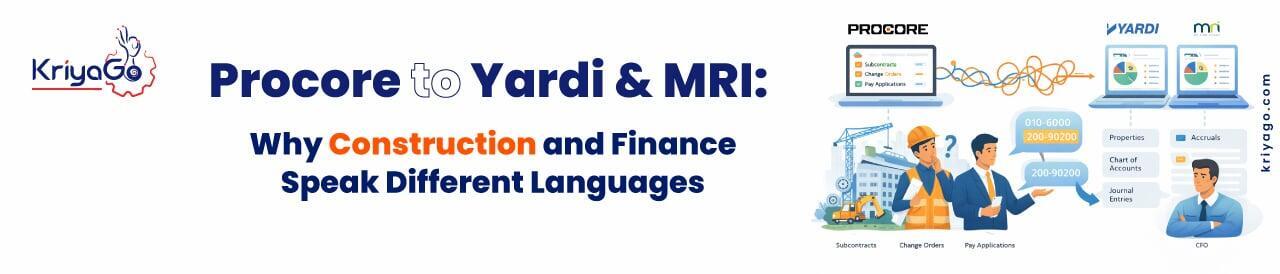
Procore is built for project managers. It operates on subcontracts, commitments, potential change orders, and pay applications. Its job cost structure reflects how construction is executed on-site phase by phase, trade by trade, with ongoing adjustments as conditions change.
Yardi Voyager and MRI Software are built for finance teams. They think in terms of properties, the chart of accounts, journal entries, and accruals. Both platforms have job cost capabilities, but they're designed to interface with accounting workflows, not to mirror the operational reality of a construction site. Whether your organization standardized on Yardi or MRI, the fundamental disconnect with construction systems remains the same.
These systems weren't designed to communicate. When they try, the conversation gets lost in translation. Cost codes don't align. Commitment structures differ. The same $47,000 change order might be classified, timed, and reported very differently depending on which system you're viewing.
The Limitations of Native Connectors
Procore, Yardi, and MRI all recognize this problem. Native connectors exist for various system pairs, and for straightforward scenarios, they work. But as EY noted in their construction technology assessment, and as KPMG has highlighted in advisory work with real estate developers, standard integrations often break down when they encounter the complexity of real-world portfolios.
The issues are predictable. Native connectors typically support new construction projects initiated after the integration is established, but what about the 15 projects already in progress? They handle standard cost code mappings well, but struggle when your chart of accounts has been customized over two decades of operations. They sync commitments cleanly until someone needs to split a contract across multiple properties or handle retainage in a non-standard way.
Deloitte's real estate technology practice has documented similar patterns: off-the-shelf integrations cover 80% of use cases, but the remaining 20%, the edge cases, legacy structures, and business-specific requirements, account for 80% of the implementation effort. Whether you're connecting Procore to Yardi or Procore to MRI, those edge cases aren't rare. They're the norm.
What Real Translation Requires
Effective middleware doesn't just move data between systems; it transforms it intelligently. A purpose-built integration layer ensures that Procore's "potential change order" maps to a specific commitment status in both Yardi and MRI, even though the platforms handle commitments differently. It knows that construction-phase codes require translation into property-level cost categories regardless of the target financial system. It handles the timing difference between when a pay application is approved in the field and when it should be posted to the books.
More critically, robust middleware handles the exceptions. When a subcontract spans multiple properties, it allocates costs according to configurable rules that work with your ERP's structure. When legacy projects need to be integrated, it provides migration pathways for both Yardi and MRI environments. When your business processes don't align with a standard connector's assumptions, it adapts rather than forcing you to change how you work.
PwC's construction practice has emphasized that successful technology integration depends on accommodating existing workflows rather than disrupting them. The same principle applies here: the best integration is one your teams barely notice because it simply works whether the data is flowing to Yardi Voyager or MRI Software.
The Multi-Platform Reality
The construction-to-finance translation challenge isn't limited to one system pair. Some organizations run Yardi for property management but MRI for investment accounting. Others have standardized MRI across their portfolio. Development pipelines might involve Northspyre or Rabbet alongside Procore. Acquisitions bring in properties running on different platforms entirely.
This is why middleware designed for real estate development needs to be multilingual. It should connect Procore to Yardi and Procore to MRI plus construction data to whatever financial systems your organization relies on today or might adopt tomorrow. The goal isn't just to solve a single integration problem; it's to build a flexible data layer that adapts as your technology stack evolves.
Building the Translation Layer
At KriyaGo, we've built our Connect 360 platform specifically to solve the construction-to-finance translation problem across the real estate ERP landscape. We connect Procore to both Yardi and MRI Software handling the standard cases efficiently and the edge cases gracefully. Our MRI Integration is available on the Procore Marketplace, and we provide equivalent depth for Yardi Voyager environments. We continue to expand our connector library based on what real estate developers actually need.
We handle cost code mappings, commitment synchronization, change order workflows, and reconciliation processes that keep construction and finance aligned regardless of which ERP system anchors your financial operations. When your project manager approves the change order on Tuesday, your CFO will see accurate numbers in Yardi, MRI, or both.
Construction and finance will always think differently. But with the right translator, they can finally understand each other.
Ready to connect your construction and finance systems?
See how KriyaGo integrates Procore with Yardi, MRI, and more. Request a demo to explore our construction integration solutions.