
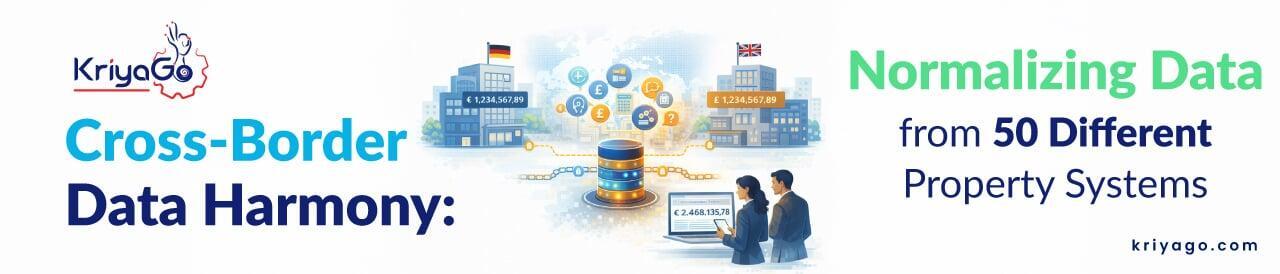
A European real estate fund with assets across ten countries faces a challenge that spreadsheets can't solve: ten property management systems, ten different date formats, ten different number conventions, and one investor base expecting consolidated quarterly reports. When your German assets report €1.234.567,89, and your UK assets report £1,234,567.89, even basic aggregation becomes an exercise in data archaeology.
This isn't a theoretical problem. Luxembourg-domiciled funds now manage over €1.5 trillion in real estate assets across Europe, and investors increasingly expect near-real-time consolidated reporting regardless of where properties are located.
Frequently Asked Questions: Cross-Border Data Challenges
Q: How do date formats actually cause problems in fund consolidation?
Date formatting varies dramatically across Europe. Germany uses DD.MM.YYYY with periods. The UK uses DD/MM/YYYY with slashes. Sweden officially uses YYYY-MM-DD (ISO format). And if you have US-based investors or assets, they expect MM/DD/YYYY. The date "01/02/2025" means January 2nd in the US and February 1st in the UK, but is invalid in ISO format. When property-level systems export transaction dates in local formats and your consolidation platform expects something different, you either get data import failures or worse, silently incorrect period assignments that corrupt your financial reporting.
Q: What about number formatting isn't that just cosmetic?
Far from it. Continental Europe uses commas as decimal separators and periods (or spaces) as thousands separators. The UK, US, and several other countries do the opposite. The number "1.234" means one thousand two hundred thirty-four in Germany, but one point two three four in the UK. Switzerland adds another layer using apostrophes for thousands separators with currency values. When your fund accounting system receives a CSV from a Spanish property manager showing rental income of "10.500,00" and interprets it as $10.50 instead of €10,500.00, you've just understated revenue by a factor of a thousand.
Q: How do time zones affect fund operations?
European funds typically operate across multiple time zones from Portugal (UTC+0/+1) to Finland (UTC+2/+3). When your Luxembourg fund administrator needs to close the books, property managers in different countries are literally operating on other days during cutoff periods. A transaction posted at 11 PM in London might appear on a different date than one posted simultaneously in Berlin. For quarterly NAV calculations and investor reporting, these timing discrepancies create reconciliation nightmares that manual processes struggle to resolve consistently.
Q: What about currency handling beyond just formatting?
Multi-currency portfolios face challenges beyond decimal separators. A fund with assets in Poland (PLN), the Czech Republic (CZK), Hungary (HUF), and the Eurozone needs consistent FX rate application across all property-level data. Which rate applies: transaction date, period-end, or weighted average? Different local systems may use different conventions. And currency symbols themselves vary: the Euro symbol (€) appears before or after the amount depending on the country, which affects data parsing when systems extract values from formatted strings.
Q: How do local property systems differ in the chart of accounts structures?
Every country has its own accounting conventions. German property managers often use the SKR03 or SKR04 chart of accounts standards. French systems follow the Plan Comptable Général. UK properties use structures aligned with FRS 102. These aren't just labelling differences; they reflect fundamentally different approaches to categorizing income, expenses, and capital items. A "service charge" in the UK might map to multiple line items in a German system. Consolidating financial data requires not just translation but intelligent transformation that preserves meaning across accounting frameworks.
The Real Cost of Data Fragmentation
Cross-border fund operations face mounting pressure from multiple directions. AIFMD reporting requirements demand consistent data across jurisdictions. SFDR sustainability disclosures require standardized ESG metrics across properties, despite different measurement conventions. Tax compliance withholding obligations, treaty access, and investor-level reporting vary by country and require accurate, properly formatted source data.
As one Waystone analysis noted, "Investors now expect consolidated, near-real-time reporting regardless of where a fund is domiciled. This puts significant pressure on data systems to deliver accurate, timely, and jurisdiction-specific outputs across multiple time zones." The challenge lies not just in producing accurate reports but in tailoring them to local templates and regulatory expectations. A one-size-fits-all approach rarely works.
Normalizing the Chaos
At KriyaGo, we've built an integration infrastructure designed explicitly for cross-border real estate operations. Our Connect 360 platform handles the data normalization that enables consolidated reporting: automatic date format detection and conversion, locale-aware number parsing, time zone alignment, currency standardization, and chart of accounts mapping across European and North American conventions.
With over 120 proprietary integration assets connecting property systems such as Yardi, MRI Software, and dozens of regional platforms, we translate local operational data into the standardized formats required by fund administrators and investor reporting systems. The middleware handles the complexity so your team can focus on analysis rather than data wrangling.
Your properties operate locally. Your investors think globally. Your data infrastructure should bridge the gap.
Ready to harmonize your cross-border property data?
See how KriyaGo normalizes data from multiple property systems into unified fund reporting. Request a demo to explore our cross-border integration solutions.